
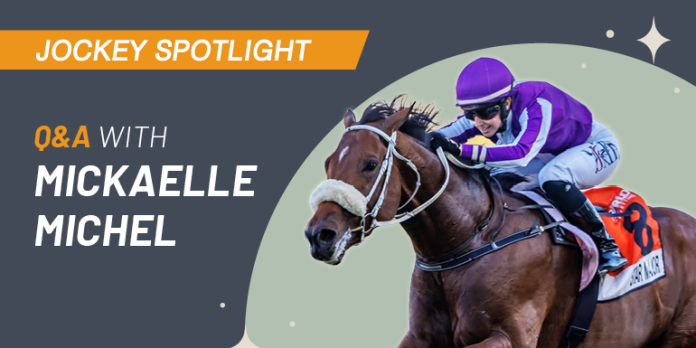

There are easier ways to make a name for yourself in South African racing than arriving from France, finding your feet in a new country, and within seven months being legged aboard the likely favourite for the Durban July.
But Mickaëlle Michel has never followed the quiet route.
The globetrotting French jockey has built a career on professionalism, adaptability and a willingness to chase opportunity wherever racing takes her. From France to Japan, Australia and now South Africa, Michel has become one of the sport’s most recognisable international riders and this weekend she has the chance to turn an already remarkable story into something truly historic.
Her mount is Star Major, the James Crawford-trained colt who has quickly become one of the most exciting horses in South Africa. The son of Querari announced himself as a serious Durban July contender with a powerful victory in the Grade 1 Daily News 2000 at Greyville, coming from near last under Michel to defeat Happy Verse and Note To Self. It was not only the biggest win of Star Major’s career, but also a landmark moment for Michel, who became the first female jockey to win a South African classic and one of only a select few women to ride a South African Grade 1 winner.
Now, the pair return to Greyville for South Africa’s greatest race, the R10 million Grade 1 Durban July, with Star Major drawn favourably in barrier four and carrying the hopes of punters who have made him the choice elect.
For Michel, this is more than another big-race ride. It is the latest chapter in a career defined by proving her ability in any jurisdiction.
She was France’s leading female rider in 2018 before taking her talents abroad, most notably to Japan, where she became a fan favourite and set a record for the most wins by a foreign jockey on the NAR circuit with 30 victories from 267 rides. Her international résumé also includes a third-place finish in Japan’s World All-Star Jockeys Championship and success in Europe, including a Group 2 victory in Italy aboard Walderbe.
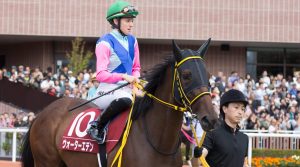
South Africa, however, has opened a new door.
Michel arrived looking for winners, experience and a fresh challenge. What she found was Star Major, a colt with acceleration, presence and the right running style for Greyville’s pressure cooker. Their partnership has already delivered consecutive major victories, including the Daily News 2000, and there is a sense that horse and rider are peaking at exactly the right moment.
The Durban July has always been a race of stories. This year, one of the strongest stories belongs to a French jockey who has travelled the world searching for the right horse, and may just have found him in South Africa.
If Star Major wins, it will be more than a famous Durban July victory.
It will be a defining moment for James Crawford, a breakthrough on the biggest South African stage for Mickaëlle Michel, and another powerful reminder that racing’s most compelling stories are often written far from home.
We caught up with Michel and she gave us a great insight into her life and journey from her perspective.
You recently guided Star Major to victory in the R2 million Gr1 Daily News 2000 at Greyville. What did that win mean to you personally and professionally?Professionally it was one of my big goals, a dream and I think an achievement to every jockey. Personally, it was a relief, my husband and I are traveling the world for many years to find a horse like him. We sacrificed a lot, so it was a beautiful way to thank my husband to trust in me and following me everywhere on this earth.
You have built an international riding career across France, Japan, Australia and now South Africa. How did your journey in racing first begin? I have ridden horses from the age of 11. I didn’t know anything about horse racing, at the age of 15yo in France you have to decide what job you want to do so you will go in a different school. Then my mum and I checked on internet what can of option I could have to work with horses and we found the AFASEC, which is the horseracing school in France. I did a test and I just fell in love with it. Horses and competing were the perfect match for me.
You became very popular during your time riding in Japan. What was that experience like, especially with the support and passion of the Japanese racing fans? It’s still one of the best experiences I ever had and that’s why to become a JRA jockey is my biggest dream from this experience. Japanese racing is special and the fans are the best. You feel all the support you need and want to become a better jockey.
Japan has one of the most intense and professional racing environments in the world. What did riding there teach you? True, they are working so hard for many years to become what they are today and win everywhere in the world! I learned to ride on the dirt over there and I loved it. It’s a different type of riding; you need to be stronger physically. I would also say the adaptation because they don’t speak English and my first year I didn’t speak English as well, Japanese culture and the way to think is very different so you need to understand quick.
You also rode in Australia and landed a winner at Flemington, the headquarters of Australian racing. How special was that moment for you? It was amazing! I was only my second meeting riding in Aussie and to win my first race specially at Flemington was something special! Plus, my horse was 80/1 so nobody expected it, me as well. So, it was a big surprise, lot of emotions and very proud.
You are now based in South Africa. What attracted you to riding there and how have you found the racing culture so far? I met Mathew De Kock in Australia when he was training with Robbie Griffiths, I had a few wins for them and when I had a dinner with him and his family before I had to leave for Japan, he told me he will go back to South Africa that year.
He followed me a little bit and knows I like to travel so he proposed me to add SA on my CV one day if I want. In 2025, I finished riding in Japan end of November and I felt it was wrong timing to fly back in France. It’s cold, races are slow and good horses are away so I decided to phone Mathew and quickly I took the decision to go there. At the beginning it was only for 5 weeks but it got well fast so I decided to extend my stay. Unfortunately, they have the same problem as almost every country, they don’t have a daily public but big races like the Durban July are well known. They have good quality of jockeys and horses; I am really enjoying it here.
Was there a particular moment early in your career when you realised you wanted to become a professional jockey? As soon as I started the horseracing school but I have to be honest I never thought it will become true until I met my first agent who became my husband. He coached me as a really professional sportsman and he gave me the confidence.
Was there a particular moment early in your career when you realised you wanted to become a professional jockey? As soon as I started the horseracing school but I have to be honest I never thought it will become true until I met my first agent who became my husband. He coached me as a really professional sportsman and he gave me the confidence.
As a French female jockey competing internationally, what challenges have you had to overcome to earn opportunities in different racing jurisdictions? Well, it’s not about being a female jockey or not, even if of course sometimes I meet some people who don’t put trust in female jockeys. But the hardest thing to do is to start from the bottom in every new country. You need to prove again, show more, sometimes it feels like I am an apprentice again because they don’t know you so you have to be very patient.
Looking ahead, what are your biggest goals in South Africa and on the international stage? I want to keep improving, win more Group 1 races and become a major jockey and have the opportunity to ride and win Group 1 races around the world.
By Scott Bailey – iRACE