
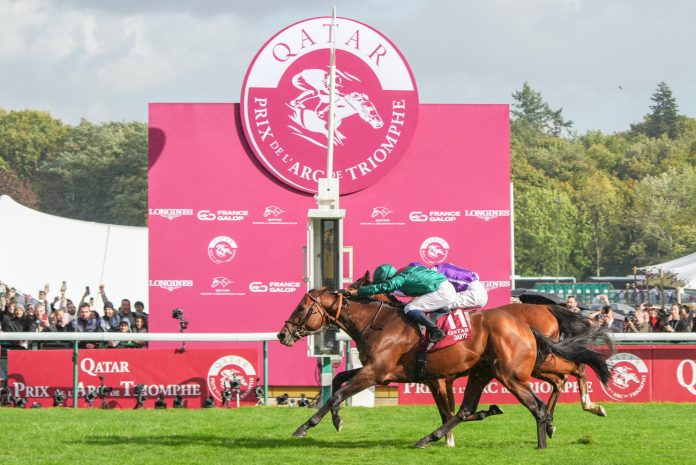

France Galop has taken a major step toward reshaping one of world racing’s most prestigious contests, with its Board of Directors overwhelmingly approving a proposal to allow geldings to compete in the Qatar Prix de l’Arc de Triomphe in 2027.
The proposal, put forward by France Galop President Guillaume de Saint-Seine, represents one of the most significant modern changes to the conditions of the Arc, a race long regarded as Europe’s premier middle-distance championship.
For more than a century, the Arc has been framed as the ultimate test for three-year-olds and older horses over 2,400 metres at ParisLongchamp. However, geldings have traditionally been excluded, reflecting the race’s historical role in identifying future breeding influence as well as racing excellence.
That position is now set to change.
France Galop’s objective is clear: to strengthen the sporting contest, broaden the race’s international appeal and ensure the Arc can present itself as a true championship event for the world’s best middle-distance horses, regardless of whether they have a future at stud.
In a statement following the Board meeting, France Galop said the move forms part of its wider ambition to establish the Qatar Prix de l’Arc de Triomphe as the undisputed global benchmark in Flat racing. By expanding the pool of eligible runners, the governing body believes the race can become more competitive, more attractive to international audiences and more compelling for spectators both at ParisLongchamp and watching around the world.
The change also fits within France Galop’s broader sportainment strategy, which seeks to make racing’s biggest events more accessible, marketable and exciting for a global audience.
The debate around geldings in the Arc has intensified in recent years, particularly with the emergence of elite gelded performers capable of competing with the best horses in Europe and beyond. Horses such as Calandagan have strengthened the argument that a championship race should be open to the best available talent, rather than restricted by breeding considerations.
Supporters of the change argue that the Arc’s modern identity is no longer limited to its breeding influence. It is now a global sporting product, a broadcast event and a race watched by fans across multiple racing jurisdictions. From that perspective, excluding top-class geldings risks weakening the spectacle and preventing the race from delivering on its promise of bringing together the best horses in training.
The decision is not without historical sensitivity. The Arc’s prestige has always been linked to its influence on the breed, and there will be those who argue that maintaining the race’s traditional conditions protects its long-established identity. But France Galop’s move signals a willingness to prioritise sporting depth and international relevance at a time when racing must compete harder than ever for mainstream attention.
There is also precedent for bold reform in French racing. The decision made during Edouard de Rothschild’s presidency to reduce the distance of the Prix du Jockey Club from 2,400 metres to 2,100 metres was controversial at the time, but it ultimately repositioned the French Derby as a more commercially relevant and internationally attractive Classic.
France Galop will be hoping this decision can have a similar long-term effect on the Arc.
For racing fans, the promise is simple but powerful: the Arc should be the race where the best three-year-olds and older horses meet over 2,400 metres at ParisLongchamp.
By Scott Bailey – iRACE