

The Prix de Diane has long stood as one of the defining races of the European season for three-year-old fillies, and this year’s edition at Chantilly has an obvious headline act.
Diamond Necklace, already a Classic winner this season, will attempt to complete a major French double when she steps up to 2100 metres in the Group 1 Prix de Diane, France’s version of the Oaks.
A field of 11 fillies has been declared for Sunday’s feature, with Diamond Necklace expected to start at the head of the market. Ryan Moore will take the ride on the Aidan O’Brien-trained daughter of St Mark’s Basilica, who has drawn well in stall three. Her Ballydoyle stablemate Moments Of Joy will also line up, with Wayne Lordan booked to ride from stall eight.
Run under set-weight conditions, the Prix de Diane is one of the great prizes on the French calendar. First staged in 1843, the race has been won by some outstanding fillies and has often shaped the second half of the European season. The honour roll includes names such as Allez France, Zarkava, Treve, Laurens, Blue Rose Cen and Nashwa, while Treve famously used her dominant Diane victory in 2013 as the platform for the first of her two Prix de l’Arc de Triomphe wins.
This year, however, much of the attention will be on whether Diamond Necklace can carry her brilliant mile form to the longer Chantilly trip.
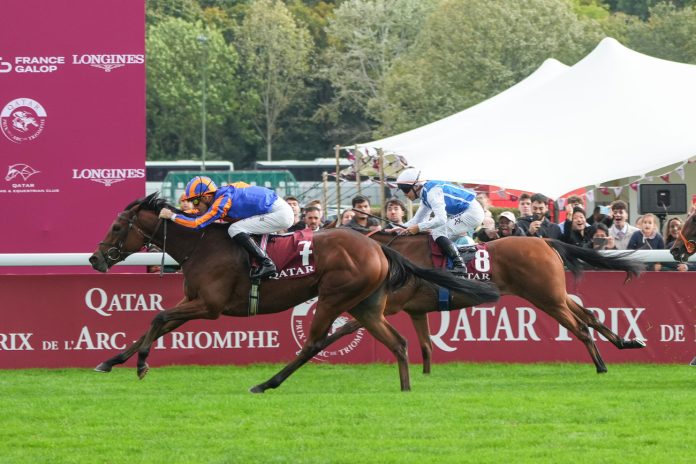
The Ballydoyle filly was highly impressive when winning the Poule d’Essai des Pouliches, the French 1000 Guineas, at ParisLongchamp. That victory confirmed her as one of the leading fillies of her generation and maintained the upward curve that began during her juvenile season, when she had already advertised her top-level ability in the Prix Marcel Boussac.
What made that last-start performance so striking was the manner of it. Diamond Necklace travelled with purpose, quickened when asked and gave the impression there was still more to come. She did not simply win a Classic; she won it like a filly with the scope to stretch further in distance and improve again.
That is the central question at Chantilly. The Prix de Diane is not a straightforward extension of Guineas form. The race asks a different question. It is run around Chantilly’s sweeping circuit, over an extended mile and a quarter, and it demands balance, rhythm and stamina as well as a sharp turn of foot.
O’Brien appears confident Diamond Necklace has the right tools for the assignment. The filly has reportedly pleased since her French Guineas success, and the plan had always been to return to France for the Diane if she came through that race in good order. Her trainer has also indicated that the step up to 2100 metres has never been viewed as a major concern.
Her sire St Mark’s Basilica improved when he moved up in distance, and Diamond Necklace has shown several similar traits: professionalism, tactical speed, balance and the ability to travel strongly before quickening. Those qualities are often vital in the Diane, where fillies can be exposed if they are too keen, too one-paced or unable to handle the track.
Better ground should also be in her favour, and from a favourable draw in stall three, Moore should have the opportunity to give her a smooth run without being forced into a difficult tactical position.
The opposition, however, is not without depth.
Green Spirit, trained by Christopher Head, adds an important French presence and knows Diamond Necklace well. She was runner-up to her in the Prix Marcel Boussac and then finished third behind her in the Poule d’Essai des Pouliches. Drawn in stall one, she gets another chance to test herself against the favourite and could be dangerous if she enjoys a soft run close to the speed.
Britain has a strong hand, with five runners declared — one more than the home team. The group is headed by Evolutionist, the Karl Burke-trained filly who finished second in the 1000 Guineas at Newmarket. She has drawn stall five and is expected to appreciate the longer trip. Burke has suggested she has strengthened since her Guineas run and that she will be ridden with more restraint this time, rather than being asked to race as prominently as she did at Newmarket.
That change in tactics could make her a serious threat if she settles and produces her turn of foot late. Diamond Necklace may be the filly they all have to beat, but Evolutionist brings high-class Classic form of her own and should not be underestimated.
Felicitas is another British-trained runner with claims. The Teofilo filly was runner-up in the Musidora Stakes at York and has drawn stall seven. That form gives her a solid middle-distance profile, and the Chantilly trip should play to her strengths if she can continue her progression.
The Ballydoyle team could also be represented strongly by Moments Of Joy, who brings a different profile to Diamond Necklace. She was seen in the Musidora Stakes at York, where the tempo may not have played fully to her strengths. She had several options on the table, including the Epsom Oaks and the Ribblesdale Stakes, but Chantilly has emerged as the preferred target. She looks like a filly who could appreciate the trip and the track, especially if the ground remains on the quicker side.
Still, the race revolves around Diamond Necklace.
The Prix de Diane has a reputation for producing elite fillies, but it is not easily won. Only the very best can combine Classic speed with the stamina and composure required at Chantilly. That is why the race has historically carried such weight, and why a victory here would significantly enhance Diamond Necklace’s status.
A win would not only give her a second French Classic of the season, it would also place her among the leading fillies in Europe and open the door to even bigger targets later in the year. The Arc has been a dream for some Diane winners, and while that conversation can wait, a strong performance on Sunday would make it difficult to ignore.
Diamond Necklace has already shown brilliance at a mile. Now she must prove she can be just as effective over 2100 metres.
By Scott Bailey – iRACE