

British racing has lost its most exciting young star after unbeaten champion Bow Echo was retired following an injury sustained in training.
The brilliant three-year-old leaves the racecourse with a perfect record of six victories from six starts, including a remarkable Group 1 treble in the 2,000 Guineas, St James’s Palace Stakes and Sussex Stakes.
His retirement brings a premature end to a career that had generated comparisons with Frankel and established Bow Echo as arguably the most exciting prospect to emerge in British racing since Sir Henry Cecil’s unbeaten champion.
Trained by George Boughey and ridden throughout his career by Billy Loughnane, Bow Echo was being considered for Sunday’s Group 1 Prix Jacques le Marois at Deauville. Instead, his thrilling victory over Gstaad at Goodwood will stand as his final appearance.
The injury is understood to involve his left fore fetlock. Although it prevents him from racing again, the colt is otherwise reported to be in good health and will now begin preparations for a stallion career.
His precise stud destination and introductory fee have not yet been confirmed.
A perfect rise through the ranks
Few horses have progressed from maiden company to the summit of European racing as quickly and convincingly as Bow Echo.
He announced himself with a four-and-a-half-length debut victory at Newbury before stepping into stakes company and winning the Listed Ascendant Stakes at Haydock.
A victory in the Group 2 Royal Lodge Stakes at Newmarket completed an unbeaten juvenile campaign and established him as one of Britain’s leading Classic contenders.
Despite his growing reputation, Bow Echo began the 2,000 Guineas at decimal odds of 5.50, the only occasion during his six-race career that he did not start favourite.
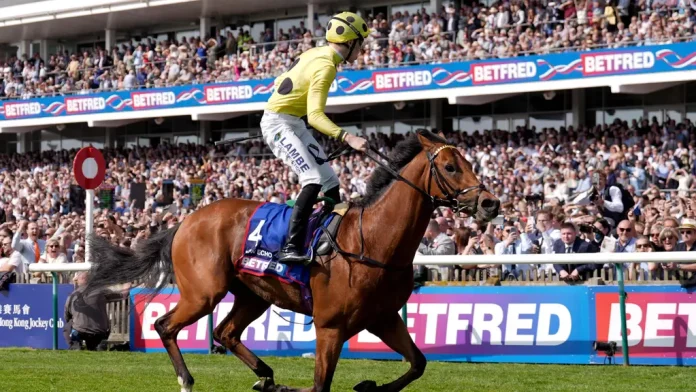
Any doubts surrounding his ability at the highest level disappeared spectacularly on the Rowley Mile.
After settling behind the leaders, he produced an explosive change of pace to defeat Gstaad by two and three-quarter lengths, with Distant Storm another eight lengths away in third.
The victory delivered a first British Classic for Loughnane and confirmed that Boughey had an exceptional colt in his stable.
Racing Post Ratings awarded Bow Echo a figure of 127 for the performance. Among 2,000 Guineas winners this century, only Frankel, who recorded 133 in 2011, and King’s Best, who earned 128 in 2000, had produced a higher figure.
His Topspeed performance of 120 was also the best recorded in the race since Frankel, reinforcing the impression that British racing had discovered a potentially extraordinary miler.
The final months of Bow Echo’s career were shaped by his compelling rivalry with Gstaad.
Having finished behind him at Newmarket, the Aidan O’Brien-trained colt strengthened the form by winning the Irish 2,000 Guineas before returning to challenge Bow Echo in the St James’s Palace Stakes at Royal Ascot.
Their second encounter was considerably closer.
Bow Echo endured interference early, raced wide and was forced to make his challenge sooner than ideal. Despite those difficulties, he found enough under pressure to withstand Gstaad in a dramatic finish.
The victory demonstrated a different side to him. Newmarket had showcased his acceleration and superiority, while Ascot revealed his determination and ability to overcome adversity.
Their rivalry resumed in the Sussex Stakes at Goodwood, where Bow Echo faced older horses for the first time.
Once again, the race did not unfold smoothly. He was caught among runners as the contest developed and appeared to have considerable ground to recover inside the closing stages.
Loughnane remained patient before asking for the colt’s decisive effort. Bow Echo accelerated through a narrowing opportunity and wore down Gstaad, prevailing by half a length to preserve his unbeaten record.
That victory made him the first horse since Frankel in 2011 to complete the 2,000 Guineas, St James’s Palace Stakes and Sussex Stakes treble in the same season. He became only the sixth horse of the Pattern era to achieve the feat.
It proved to be a fitting, if unexpectedly final, demonstration of his talent.
A career intertwined with Loughnane
The emergence of Bow Echo was closely connected to the rapid rise of Billy Loughnane.
The young jockey partnered him in all six starts and was entrusted with the colt throughout his development from an inexperienced juvenile into Europe’s outstanding three-year-old miler.
Loughnane displayed composure during each of their major victories. He allowed Bow Echo to use his acceleration at Newmarket, recovered from a difficult passage at Ascot and held his nerve when briefly trapped behind runners at Goodwood.
For a jockey still in the formative stages of his career, finding a horse of such quality was an opportunity few riders experience so early.
Their association gave British racing a compelling partnership between an unbeaten star and one of the most talented members of a new generation of jockeys.
A lasting tribute to Sheikh Mohammed Obaid
The story carries additional emotion because Bow Echo was bred by the late Sheikh Mohammed Obaid Al Maktoum, who died before seeing the colt fulfil his potential on the racecourse.
The owner-breeder spent decades developing successful thoroughbred families, and Bow Echo emerged as one of the finest products of that breeding programme.
By champion sire Night Of Thunder, he is a grandson of influential stallion Dubawi and is out of the three-time winner Aristocratic Lady.
His dam is by Invincible Spirit and is a half-sister to two stakes winners, including Group 1-placed Royal Rhyme. The combination of elite racecourse performance, an unbeaten record and an established international pedigree makes Bow Echo an exceptionally attractive stallion prospect.
He also represents an important extension of the Dubawi sire line. Night Of Thunder has established himself among Europe’s leading stallions, and his son now retires as one of his finest performers.
Darley described Bow Echo as an outstanding representative of his sire and one of the most exciting horses to enter the breeding ranks in recent years. However, the organisation has stated that his formal stud plans will be confirmed later.
The unanswered question
The frustration surrounding his retirement comes from what remained possible.
Bow Echo had completed the defining three-year-old mile programme in Britain and remained unbeaten after defeating high-class opposition under contrasting circumstances.
A potential appearance in the Prix Jacques le Marois would have offered another international test, while later targets could have included races such as the Queen Elizabeth II Stakes or Breeders’ Cup Mile.
Those opportunities have now disappeared, leaving racing followers to wonder how far his ability might have carried him.
It would be premature to place Bow Echo alongside Frankel on pure performance. His peak Racing Post Rating of 127 remained six pounds below the figure produced by Frankel in the 2,000 Guineas and beneath the highest ratings achieved by champions such as Baaeed and Kingman.
The comparison instead reflects the excitement he created.
Like Frankel, he won the 2,000 Guineas with a performance that immediately separated him from his generation. He then travelled to Royal Ascot and Goodwood to complete the same historic Group 1 treble while maintaining his unbeaten record.
The difference is that Frankel was able to race on and demonstrate the full extent of his greatness. Bow Echo’s career ended before his ceiling could be discovered.
That unanswered question will always form part of his legacy.
Six starts, six victories and three Group 1 triumphs represent a career without defeat or disappointment on the racecourse. He conquered Newmarket, Royal Ascot and Goodwood, defeated his strongest rival three times and provided British racing with its most captivating new star.
His time on the track was desperately brief, but Bow Echo achieved enough to be remembered as one of the outstanding milers of his generation and one of the most exciting unbeaten horses Britain has produced since Frankel.
By Scott Bailey