

The newly renamed G1 Prix Aga Khan IV, formerly known as the Prix d’Ispahan, brings together a small field of five but fascinating field at Longchamp this Thursday, with Daryz the headline act as he looks to continue his rise as one of Europe’s most exciting middle-distance stars.
Run over 1850 metres, the race has long held an important position on the French racing calendar. Its distance creates an interesting test, sitting between a traditional mile and the more stamina-focused 2000-metre and 2400-metre Group 1 contests. It often attracts a mix of genuine milers, strong 2000-metre performers and horses capable of stretching out further, which can make the tactical shape of the race just as important as raw ability.
This year’s edition may be small in numbers, but it is not short on quality. Daryz, Sosie and Leffard give the race a strong top-end profile, while Qilin Queen and Divine Chrisnat face a much tougher task on ratings and exposed form.
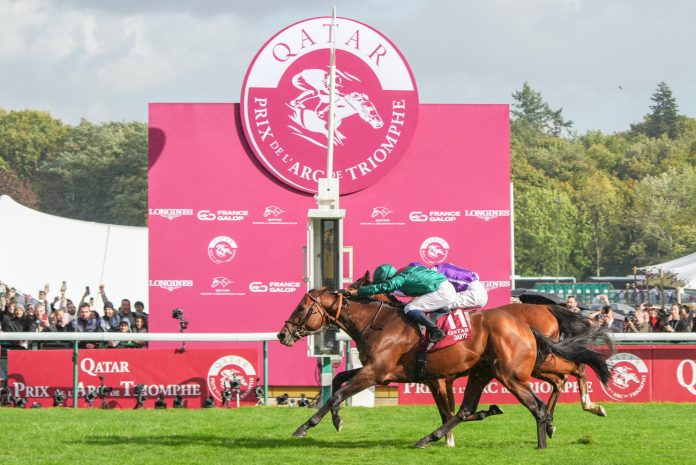
For Daryz, the story is particularly fitting. He lines up in a Group 1 now carrying the Aga Khan name, and he does so as one of the standout horses in training. His victory in last year’s Prix de l’Arc de Triomphe was the performance that elevated him from a highly promising colt into a genuine champion. He showed class and a powerful finishing burst to win Europe’s most prestigious race, and that success immediately made him the horse others now have to measure up against.
What has been just as impressive is the way he returned this season. A champion can sometimes need a run after a major campaign, but Daryz wasted no time reminding everyone of his quality when resuming with victory in the Prix Ganay at Longchamp. That performance showed he had trained on, retained his turn of foot and still possessed the professionalism required to win at the highest level.
The slight query this Thursday is not whether Daryz is the best horse in the race. On exposed form, he clearly is. The question is whether the 1850-metre distance is sharp enough to make him vulnerable. His biggest performances have come when his stamina and strength have been allowed to come into play, especially at 2400 metres. Over this shorter trip, particularly in a small field, he may not have the luxury of a truly run race.
If the tempo is steady and the race turns into a sprint from the false straight, his rider will need to have him close enough to strike. However, top-class horses often have the ability to overcome these types of scenarios. If Daryz is within range when the field straightens, he has the class and finishing power to take control.
Sosie looks the most obvious danger. He is a proven International Group 1 performer and brings serious credentials into the race. He won this contest last year when it was still run as the Prix d’Ispahan, and that piece of form alone makes him a major player. He has also shown his quality at the highest level over further, including when finishing third in the Arc behind Daryz and a Hong Kong Vase win last December.
The key with Sosie is that this distance should suit him well. He has enough stamina to be effective over longer trips, but he also has the tactical pace to be dangerous around 1850 metres. That makes him a genuine threat if the race becomes tactical. He is not a horse who needs everything to fall apart to be competitive; he has the class, course experience and distance suitability to make Daryz work.
If there is one runner capable of turning this into a proper race, it is Sosie. He knows how to win at this level, he handles the track and he has already proven himself in this exact type of contest. He may not carry the same star power as Daryz, but he is far more than just a supporting act.
Leffard adds another layer of intrigue. His victory in the Grand Prix de Paris showed he has a serious engine and a liking for Longchamp, producing the kind of performance that marked him as a high-class horse with staying strength. The challenge for him here is the drop back to 1850 metres.
Leffard is likely to be at his best when the race becomes a genuine test. If they go hard enough early, or if stamina becomes important late, he can certainly run into the finish. But if the race is slowly run and turns into a sharp sprint, he may find himself needing momentum at exactly the wrong time.
That does not mean he should be underestimated. He has Group 1 ability, Longchamp form and the profile of a horse who can make his presence felt if the race is run to suit. But of the main trio, he is probably the one most dependent on the tempo.
Qilin Queen and Divine Chrisnat look up against it. Both appear to be facing a significant class test against three well-credentialed rivals, and they would need to produce clear career-best performances to trouble the main chances. In a small field, though, outsiders can sometimes sneak into the race if the favourites watch each other or if the tempo becomes messy. Their best hope may be to take advantage of any tactical hesitation among the leading contenders.
Still, this race looks to revolve around Daryz. He has the strongest form, the biggest profile and the most compelling recent performance. Sosie has the right credentials to test him, while Leffard has the class to make things interesting if stamina becomes a factor.
Small fields can often become tactical, and that is probably the only real danger for Daryz. But if the race turns into a true contest of ability, the Arc winner is clearly the horse they all have to get past.
Daryz is the headline act, and Thursday gives him the chance to further strengthen his position as one of Europe’s leading middle-distance performers.
By Scott Bailey